


Earl's Recent Past Golf Blog's
November 6,2025Basic Short Wedge Pitch and a bit more
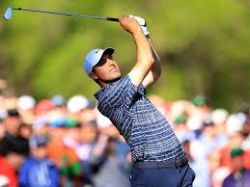 PGA touring professionals are exceptional at every facet of the game, but one trait above all others is essential to sustaining success throughout their careers: the short game around the greens. You can't reach the PGA Tour without being a solid ball striker and a good putter—but to stay among the elite and enjoy longevity, you must have a stellar wedge game.
The average player has no idea how good Scottie Scheffler is with a wedge in his hands. We're impressed with 350-yard drives, but the real artistry lies in how close he hits those finesse wedge shots to gimme range. The average Tour professional hits about 13 greens in regulation per round, which means he faces about five delicate short shots that must be executed perfectly to save par. Add in the "up and downs" on par fives and approach shots inside 100 yards, and the importance of mastering the wedge becomes undeniable.
Paul Runyan, one of the greats of the 1930s and '40s, was renowned for his excellence around the greens. I had the privilege of attending a PGA seminar with Mr. Runyan at Houston Country Club in 1980, where he shared his wisdom for three days. Much of the instruction took place on the course and focused on how to make subtle adjustments to control ball flight and spin. One statement of his still amazes me today: he said he had at least a hundred different ways to play a simple, straightforward 20- to 40-yard pitch or chip shot. He demonstrated varying heights, spins, hooks, slices, and club selections—never leaving a ball more than five feet from the hole and holing out an astonishing number of times.
Let's talk basics, because all those variations stem from a solid foundation. Take a 20-yard level shot with plenty of green to work with, using a 56-degree sand wedge. Stand erect with your feet relatively close together and a little more weight on your front foot. Position the ball in the center, with the shaft straight up or slightly leaning forward. The body's movement matches the shot's length: quiet on short shots, turning more as the swing lengthens. The backswing creates the energy for the shot—once you've taken the club back far enough to produce the desired distance, simply swing it along the path back to the ball and let it stop naturally after impact. The backswing will generally be longer than the follow-through. There's no need to force acceleration—doing so kills feel, and feel is everything in finesse shots. Mr. Runyan said, "It's like letting the club drop and therefore using gravity to swing it back to the ball."
This is just one of the hundreds of ways to play a wedge shot around the green, but these fundamentals apply to at least 75% of the shots most amateurs will face.


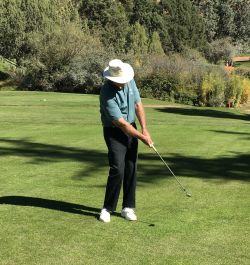
Now for the fun part. Once the fundamentals are in place, start expanding your shot repertoire. Begin with the basic 56-degree sand wedge from 20 yards. Experiment with different ball positions—forward, back, slightly open face, half open face—and with various clubs. Observe how trajectory and spin change with each adjustment. With a bit of practice, you'll find a reliable, comfortable shot you can trust. Then expand the distances, remembering this rule: the length of your backswing creates the power. Follow that rule, and you'll develop a confident short game that can shave strokes off your scorecard.
October 02,2025
The Sad Legacy of this years Ryder Cup
 I love the Ryder Cup. I love the passion in the players that is always on full display. I love match play, the matches within matches, and the clash of personalities against egos. I love Friday morning matches that actually matter. I love the strategy behind the pairings and the subtle gamesmanship. I love crowds that cheer and show their loyalties. I love that golf tests your core strengths while exposing your weaknesses. I love that captains must make tough decisions, knowing they will be second-guessed. I love greatness—and great golf—emerging in ultra-pressure situations.
But this Ryder Cup should be a blueprint for what not to do. You cannot bring such a prestigious event to a place where bedlam and chaos are almost guaranteed. New Yorkers are known for being loud, raucous, and often obscene. There should have been strict safeguards to prevent that kind of behavior. This is supposed to be a gentleman's sport, not a hockey-like brawl. Shame on the PGA of America for allowing it to get out of hand. I'm just glad no one was injured. As a PGA member, I apologize.
If you can look past the ugliness of the crowd, there was great golf played. Bethpage Black is a monster of a course, but it was reduced to a pussycat last week. I've played it and can attest to its severity. Yet with generous fairways, virtually no rough, lift-clean-and-place rules, and soft greens, the course lost its bite. That setup was Captain Keegan Bradley's first mistake, and it backfired.
Friday morning, the Americans needed a fast start. Losing early matches is ominous if you hope to win the Cup. Bryson DeChambeau teamed with Justin Thomas against Europe's best foursome team, Jon Rahm and Tyrrell Hatton. It was strength against strength, but three players performed while Thomas faltered, and the U.S. was drilled. The second match seemed like a U.S. lock—world No. 1 Scottie Scheffler paired with steady, straight-hitting Russell Henley. Instead, there was no chemistry, and they lost convincingly to Ludvig Åberg and Matt Fitzpatrick. Then, with their backs to the wall, Bradley sent out Harris English and Collin Morikawa against Rory McIlroy and Tommy Fleetwood. With no alpha leader to rally the team, they looked outmatched from the start and lost decisively. Only Xander Schauffele and Patrick Cantlay managed to salvage a point, giving the morning session a faint glimmer of hope.
The afternoon matches effectively sealed the Americans' fate. Scheffler and J.J. Spaun lost easily to Rahm and Sepp Straka, while Justin Rose and Fleetwood dispatched DeChambeau and Ben Griffin. By the end of Friday, Europe led 5½ to 1½. The match was essentially over.
There were, however, bright spots for the U.S. Cameron Young emerged as a star. Whenever the team needed a clutch shot, he delivered. His only loss came with Thomas in Saturday's four-ball, when they fell on the 18th hole to McIlroy and Shane Lowry. Young finished with three points, all statement wins. Schauffele also finished with three points and one loss, as expected. The biggest disappointment was Scheffler, who managed just one win against four losses. How does the best player in the world struggle so much? Simple—his partners often failed to contribute, and his putter went cold. Even when paired effectively with Bryson, they ran into a buzzsaw in Rose and Fleetwood. Rose made nine birdies in 16 holes, answering every U.S. highlight with an even better shot of his own. By the end of day two, the score was 11½ to 4½. Sunday singles became little more than a formality. To their credit, the Americans fought hard, winning six matches, tying four, and losing just one. Add another half point when Viktor Hovland was forced to withdraw due to injury, and the final margin was 15–13. The score looked close, but the reality was clear—the match had long been decided.
What went wrong? Keegan Bradley was a good choice as captain, and his leadership and commitment were beyond question. But he made mistakes. The course setup was too soft. Some pairings—especially Morikawa and English—were never competitive. The Scheffler–Henley pairing seemed like a natural fit, but it collapsed completely. If just one of those matchups had worked, the outcome might have been very different. On the other side, Luke Donald pushed all the right buttons. He had a battle-tested team that returned 11 of the 12 players from their victory in Italy two years ago. He knew which friendships worked and which pairings clicked. Bradley, by contrast, had just one proven duo in Schauffele and Cantlay. Donald had a blueprint; Bradley had to guess.
I watched nearly 90 percent of the matches. My conclusion: the Europeans simply played better. They had more players capable of withstanding the hostile crowds and more who thrived under this type of pressure. Every time the Americans produced a great shot, Europe answered with something even better. They played superior golf, and they showed grace and sportsmanship in the process. The final legacy of this Ryder Cup is twofold. Europe deserved their win, playing brilliantly under fire. But New York's poor sportsmanship and the PGA of America's failure to protect the spirit of the event will be remembered just as much. A sad legacy that will forever be tied to the 45th playing of the Ryder Cup.