

Earl's Recent Past Golf Blog's
July 18, 2026
Bryson and the rules controversy
 Bryson DeChambeau was assessed a two-stroke penalty during the second round of The Open Championship at Royal Birkdale for improving his lie. In a major championship, where every stroke matters, the R&A does not issue a penalty of this magnitude without carefully reviewing the evidence. Penalizing one of the game's marquee players while he is in contention is a serious decision.
Every knowledgeable golfer understands that improving a lie or altering the conditions affecting a stroke is prohibited. Bryson certainly knows that. Throughout his professional career, he has never developed a reputation for intentionally skirting the Rules of Golf. Whether the act was intentional or accidental, however, the video evidence clearly showed that he improved his lie. Under the Rules, the penalty was appropriate. Given the facts, the best response is to accept the ruling and move on. Instead, Bryson was visibly upset and passionately argued his case. He had every right to do so. But according to reports from lip readers, he told officials that if they imposed the two-stroke penalty, he would withdraw from the championship. That's childish and immature. It's difficult to imagine Jack Nicklaus, Tom Watson, Tiger Woods, or Scottie Scheffler making such a statement to a rules official.
DeChambeau has long been one of golf's polarizing figures. To his credit, he has worked to reshape his public image, and many fans appreciate his unconventional, aggressive approach to the game. Yet he has also shown that he doesn't mind being the center of attention. His handling of this incident raises questions about how much that image has truly changed.
After the ruling, DeChambeau declined to speak with reporters and television crews, choosing instead to hit balls on the practice range to cool off. He later released a brief statement: "Obviously disappointed with the ruling. I don't agree with it, but it is what it is. This fires me up. Onto the weekend. Let's get it." It will be interesting to see how the British galleries respond when Bryson tees off this weekend. My own opinion of him has declined and disappointed. While I wish him no ill will, I won't be rooting for him.
It's unfortunate that Friday's story became the controversy surrounding DeChambeau rather than the remarkable rounds of 62 by Sam Burns and Lucas Herbert. Those performances deserved to be the headlines. Hopefully, the 154th Open Championship will ultimately be remembered for great golf rather than one rules controversy.
June 22, 2026
Validation comes with two!
p>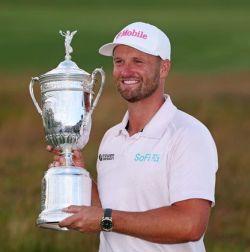 Winning one U.S. Open is a remarkable accomplishment. Winning a second validates that achievement and confirms a player's place among the game's elite.
Wyndham Clark has now earned the distinction of being a two-time U.S. Open champion. His opening-round 64 at Shinnecock Hills was a brilliant display of shot-making and putting on a day when many of the world's best players struggled simply to stay within striking distance. From that point forward, Clark faced the challenge of protecting a lead while navigating the peculiarities of one of golf's most demanding venues. In the end, he proved to be the strongest competitor and the last man standing.
As I watched Clark throughout the week, I was struck by his similarities to another two-time U.S. Open champion, Bryson DeChambeau. To me, Clark is a mini version of Bryson—strong, aggressive, and highly mechanical in his approach to the game. Both players make golf look difficult, as if every component of their swings, short game and putting must be perfectly aligned for success.
After the second round, Clark's ball-striking became somewhat inconsistent. He appeared to take longer deciding and preparing for his shots, leading at times to indecision, missed fairways, and missed greens. What ultimately carried him to victory was an exceptional short game and superb putting. Maintaining that level of touch and concentration under U.S. Open pressure requires tremendous mental fortitude. This week, Clark was simply the best.
Through his PGA Tour career, Clark has not been considered an elite putter. However, during his victory at Los Angeles Country Club in 2023, he enjoyed an extraordinary week on the greens. Following that win, his swing mechanics deteriorated somewhat, and with them, the confidence that fueled his putting success. A new coach helped restore his swing, and after experimenting with several putters, he appears to have found a putter and stroke that suits him again.
Statistically, many Tour players experience six-week stretches when every part of their game comes together. Clark, with his win in Dallas and high finishes the past two weeks, appears to be in one of those periods. Following his win at LACC, his performance level declined before eventually rebounding this year. My prediction is that he will once again settle back somewhat—not dramatically, but enough to remain just below the sustained high level of players like Scottie Scheffler and Rory McIlroy. Great putters tend to remain consistently effective. Average Tour putters tend to run hot and cold. Wyndham is due to cool off a bit.
The USGA should be very pleased with this year's championship. There was no controversy surrounding the course setup, and a winning score of four-under par demonstrated that the course did not need to be artificially toughened to provide a stern test. Weather, as always, was the unpredictable factor and played a significant role throughout the week, particularly during the opening round.
Luck is always part of the U.S. Open experience. Favorable bounces, playable lies in the fescue, and fortunate breaks can influence the outcome. It certainly seemed that Clark enjoyed his share of good fortune during the week. But his victory was about more than luck—it was about capitalizing on opportunities when they presented themselves and executing under pressure when it mattered most.
The stars have aligned twice for Wyndham Clark. Will it happen again? If it does, it wouldn't be luck!